
Like many other people, I read a huge amount of stuff on environmental matters every day, such as on the climate disaster-in-the-making, overconsumption, pollution of the environment by plastic and other man-made materials, extinction of animals and insects, and, at the root of it all, overpopulation. It is a very worrying scenario. which threatens to bring civilized life as we know it to an end.
But last week I have been brought up short by confronting the other end of the progress of humanity, while on holiday in Orkney. Here I, along with many other tourists, saw the evidence of the challenges our species faced at the time humans first reached Northern Europe, arriving in a pristine world of fertile soil, abundant fish in the ocean, an abundance of stone, and a few trees. It made me think of the journey humanity has made, the achievements in material things, in thought, in the richness of human life all over the globe. The ultimate success of the vast expansion of human numbers must have been quite unimaginable to that tiny number of humans in those early times, who faced daily existential challenges which often must have made them think they would not survive as a group at all. But since then, a multitude of civilizations have grown and died, and technical and scientific wonders have been created. But to what purpose? And how will it all end?
The first evidence of humans in Orkney was just after the last ice age, around 9,000 years ago, during the Mesolithic period (middle stone age).
At that time what is now known as the British Isles was joined to the continent by a flat plain known as Doggerland, now deep under the North Sea. Orkney was joined to the mainland further south, and so the first inhabitants probably got there on foot from Doggerland, which was a rich area, with a coastline of lagoons, marshes, mudflats, and beaches, where there were rich hunting and fishing grounds. The people lived in small nomadic bands, and most or all of their food was obtained by picking wild plant, fishing and hunting wild animals.
But the long cold winters must have been very difficult to survive, and they left little trace – a few tools, ornaments, bones. Gradually (as is happening again now), the climate warmed and the ice caps melted, so that the water released from ice sheets and glaciers, raised the sea level, breaking off Ireland on the west side and Britain from the continent on the other side. This happened gradually but the final inundation of Doggerland and the separation of Britain from Europe happened with the Storegga Slide, a huge tsunami off the coast of Norway around 6,100 years ago.
Eventually Orkney broke off too at the north end, and was then a single landmass, rather than a collection of islands. As global warming continued Orkney became a good place to live, with temperatures about 7 degrees higher than now, fertile soils and seas teeming with fish, because it was in the path of the Gulf Stream. So when Neolithic farmers, who came from a completely different grouping of people from the earlier nomads (with separate maternal DNA), arrived around 6,000 years ago, they found an excellent area where they could farm and keep animals. It was so rich that there was plenty of food, so they could afford to build houses to live in, and also build some of the amazing structures for burial and ceremonial purposes that can be seen on the island.
The oldest that I saw were dated 5,500 years ago and were cairns – tombs for the burial of their ancestors, which was so important to their culture. They were quite elaborate stone built structures showing great skill in manipulating huge slabs of heavy stone.
.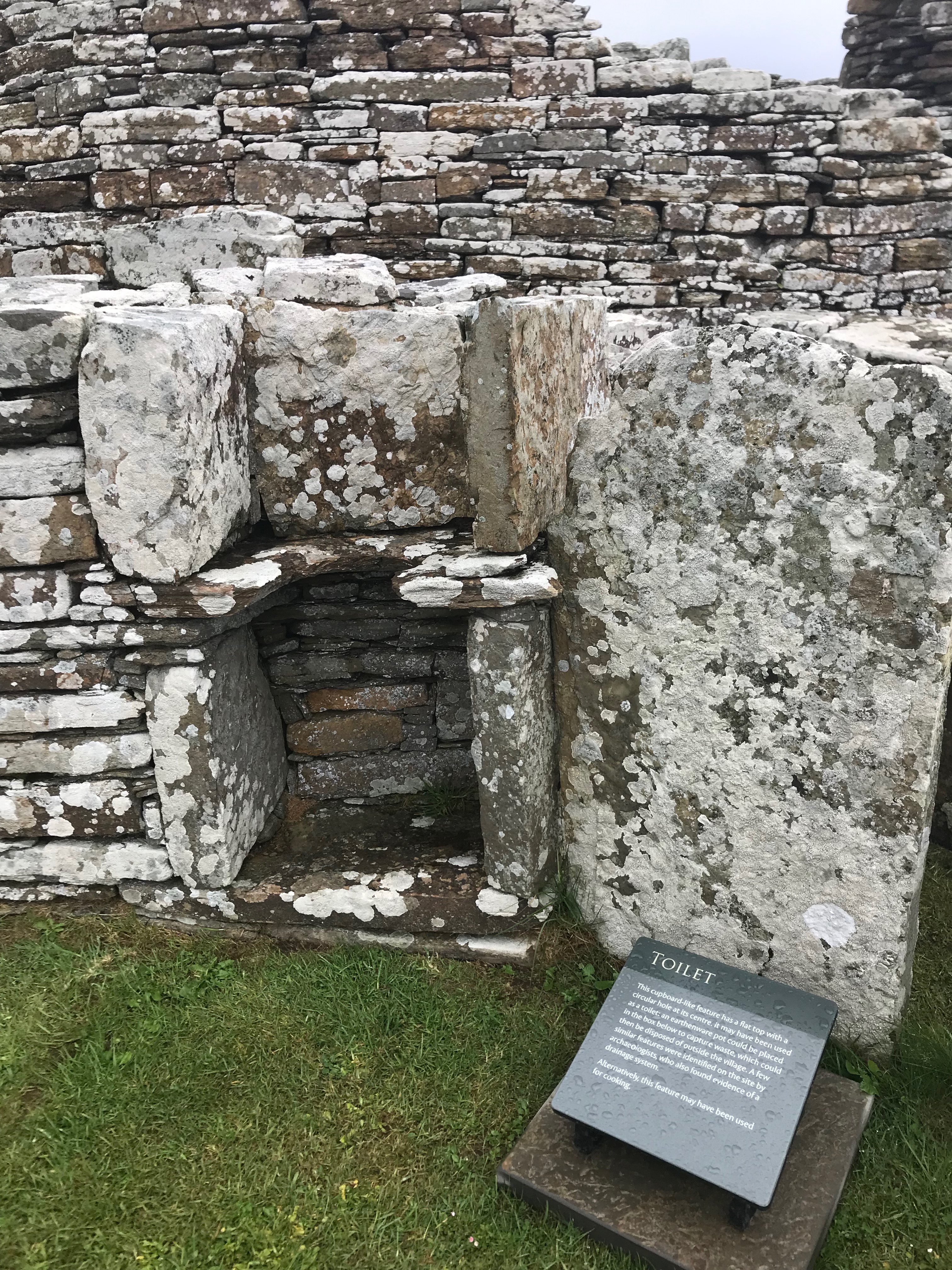
Skara Bray – possibly a prehistoric toilet (or a cupboard!)
But we also saw the remains of a farmstead, villages and individual houses, (Knap of Howar, single farmhouse 5,500 – 5,000 years ago; Barnhouse village 5000 years ago) which showed how they lived with complete shelter all those years ago. Skara Brae, the most complete village of them all, was occupied between 5,100 and 4,500 and was abandoned by 4,000 years ago.
Farming revolutionized human society, and allowed populations to grow for the first time. But it wasn’t a quick fix, and populations grew and then were decimated by famine, disease, and in Orkney especially, the long winters. Child mortality was huge in these villages that we saw, newly restored by archeologists, in Skara Brae and Barnhouse. Just think of how winter in warmer countries can kill young babies nowadays when conditions are poor, such as in refugee camps. Fertility rites were very strong, and the survival of children must have been the most important goal for the whole society. Pronatalism – encouraging child-bearing and elevating fecundity above all else – was absolutely essential then. (Although it was also promulgated by old men, who, as now, saw many descendants as a source of power). Life itself was very precious, and people tried to prolong it in their minds by venerating their ancestors – hence the huge emphasis on burial rites with the building of cairns, brochs, etc.
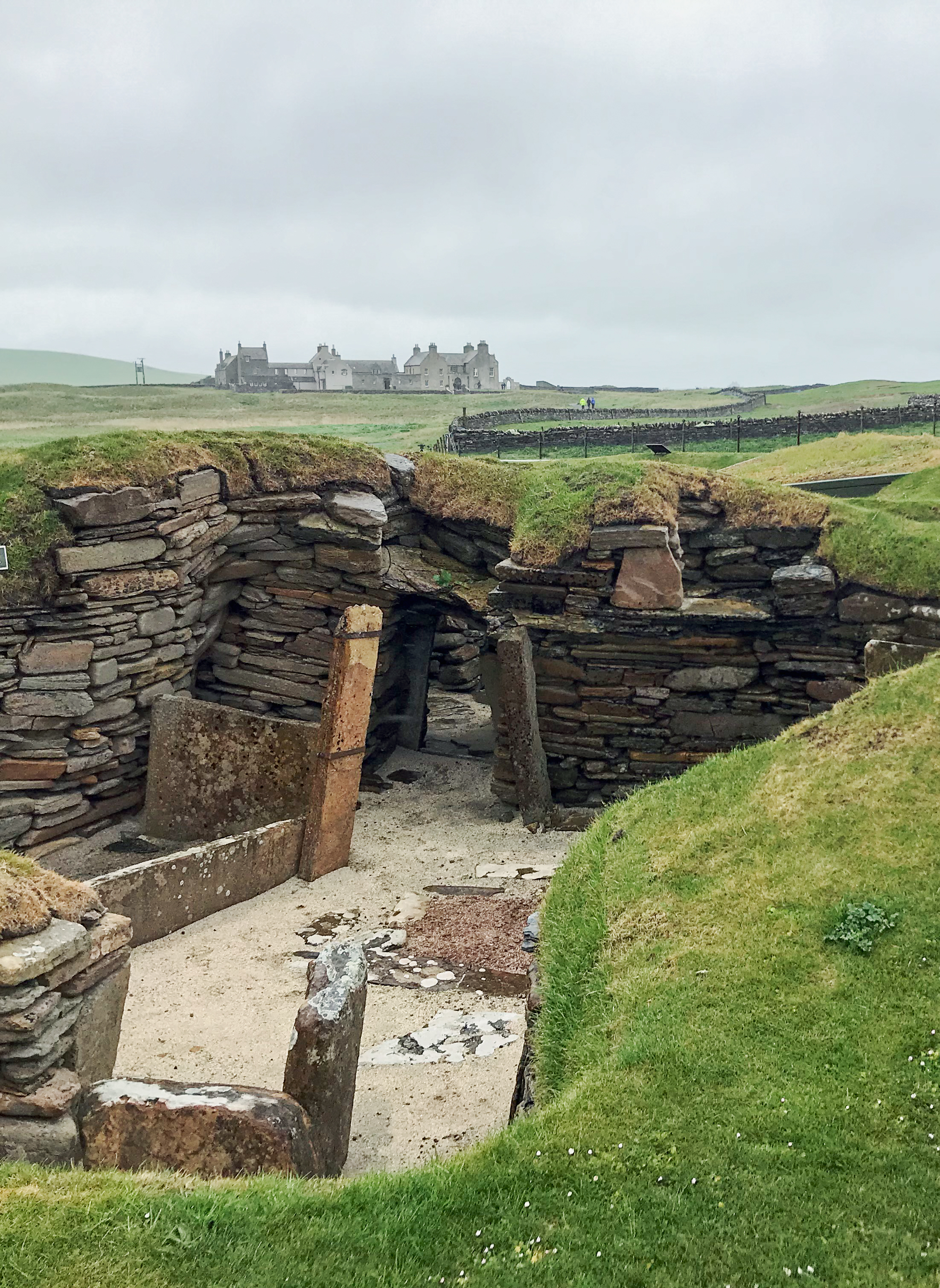
Skara Bray
People must have dreaded the winter, when death stalked constantly, but conversely the winter solstice, the turning of the year heralding the coming of spring, would have been a signal for great rejoicing. So they built Maes Howe – a huge stone monument to that important time so that they could know exactly when it came. They designed it so that they captured the first sign of the winter solstice, when the rays of the setting sun over the hills of Hoy, came down over the top of the Barnhouse stone, so that it illuminated the wall of the back chamber and the back cell. Once this appeared, people would know that the shortest day had arrived, and there was hope for next spring. What a feat of engineering, for our forebears 5,000 years ago. Life was hard, and people had to be energized by community acts and beliefs.
Maes Howe was started 5,000 years ago and was certainly in use by 4,700 years ago so it was among the first of its kind in human existence. The earliest Egyptian Pyramids were built around 4,600 years ago, and Stonehenge 4,500 years ago. What a treasure we have in Britain.
Global warming and rising sea levels eventually continued until 4,000 years ago when Orkney became an archipelago and the golden age disappeared. There was pressure for resources as the land disappeared, and many people left their villages abandoning these monuments. But a later people, the Picts, arrived with iron age technology, bronze, iron , jewelry and ornaments, in successive waves from the mainland where they had set up a kingdom, and there is documented evidence of this from 2,000 years ago (1st century AD). The Romans never came to Orkney although some Roman artifacts were found, showing that the Neolithic farmers traded with them. Then suddenly the Picts disappeared and were taken over by Vikings, destroying their culture. And so on, one culture after another throughout the following two millennia.
So fast-forward to modern times. We now have an unprecedented level of comfort and security, when nearly all children survive, old people’s lives can be prolonged, and there people think there should be a cure, as of right, for every illness. But the cult of the sanctity of human life still takes precedence above all other forms of life, through religion or cultural myths. This has all been hard-wired in all of us for at least 5,000 years. There is now no acceptance of the inevitability of death, just an all-pervading sense of our own well-being and, within many groups, that God, or some other non-human power, will continue to ensure this.
Those of us who put the population explosion at the heart of the causation of the coming destruction of the planet’s resources, and hope to stem the tide of pro-natalism, need, I think, to remember that it is only in the last 50 years – a twinkling of an eye – that human lives have improved so much so that almost all children survive to reproduce and lifespans are increased sometimes by 50%. To expect humanity to suddenly realise that we are now the problem is unrealistic.
There won’t be a feeling of thanks that we, who have been given so much, should accept some reduction in comfort or lifespan so that the natural world can continue. We, as selfish human beings, won’t give up anything even though death and destruction are staring us in the face. We started out all those years ago in a world of terrible challenges, with a huge drive to survive. This took us, through innumerable wars, famines and natural disasters, to a point when we now don’t realise that our sheer numbers are destroying the planet. No wonder we can’t escape our early conditioning. The intelligent ape is a prisoner of his own history.
That is the lesson of Orkney for me. Our success at dominating the world, against all the odds, was because of our single-minded imperative to make sure we go forth and multiply, and this has to be recognized now as our greatest threat. Yes, we need to empower women to take control of their own fertility, as women bear the cost of this drive to multiply and it has been proved time and time again that women will make rational choices to have smaller families if given education and contraception. But I’m not sure that it won’t be necessary to inject some old-fashioned fear (as of Hell) into our leaders to make the right choices for ourselves and our planet. It seems that our children are now experiencing that fear, and agitating for better policies (although I haven’t seen any signs that they are agitating for fewer children to be born). But all power to them. They are the ones to direct humanity to a better future. Our planet will survive. But we, and our civilizations, won’t unless we start to control this age-old urge to go forth and multiply.


 Elen Samuel, doctor and writer